

The Call of the Desert
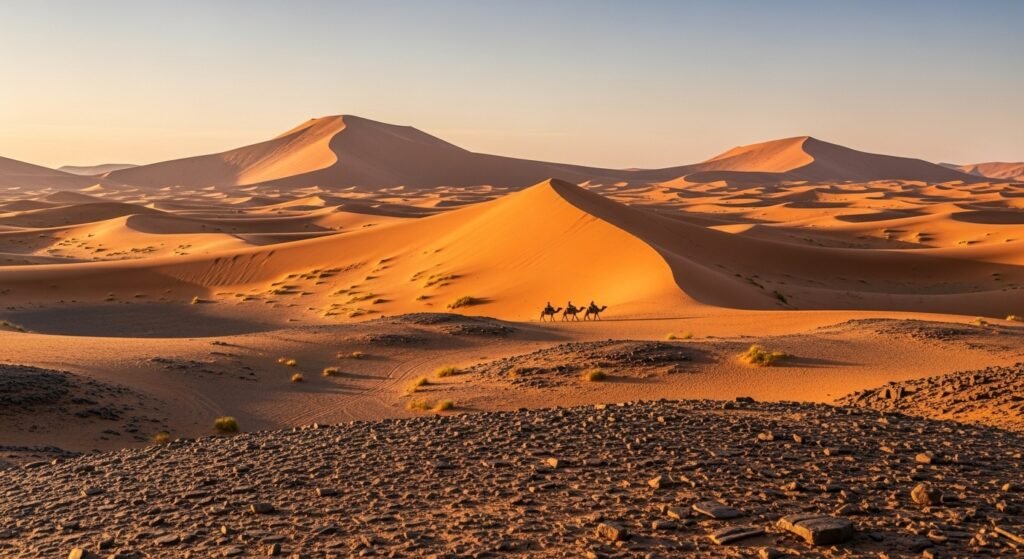
There are places we visit, and there are places that transform us. The Moroccan Sahara belongs to the latter category. It is much more than a landscape of sand and sky; it is a sensory experience that resonates deep within the soul. It is an invitation to silence, introspection, and a rhythm where time is measured by the sun and the stars.
On this journey, Ouarzazate reveals itself as the “Gateway to the Desert.” It is here, on this threshold between civilization and the vast ochre expanse, that the true adventure begins. For Fauna, traveling to the Sahara is not just about crossing dunes, but about immersing oneself deeply in the ancestral culture, in the landscape that speaks, and in the silence that teaches.
Part 1: Ouarzazate, the Hollywood of Morocco and Guardian of the Kasbahs
Before the sand becomes the only thing on the horizon, Ouarzazate captivates visitors with its unique blend of history, cinema, and monumental architecture. It is a city that serves as a film set, built from the very earth that surrounds it.
Ouarzazate and Cinema
Its nickname, “African Hollywood,” is no exaggeration. The region’s golden light and biblical landscapes have been attracting filmmakers for decades. At Atlas Film Studios, you can walk through sets from iconic films like “Gladiator” and “The Mummy,” feeling like you’re part of cinematic history.
For an even more immersive experience, the Film Museum—located in a former studio—offers a fascinating behind-the-scenes tour featuring costumes, equipment, and the magic of major film productions.
Architectural Treasures: Kasbahs and Ksars
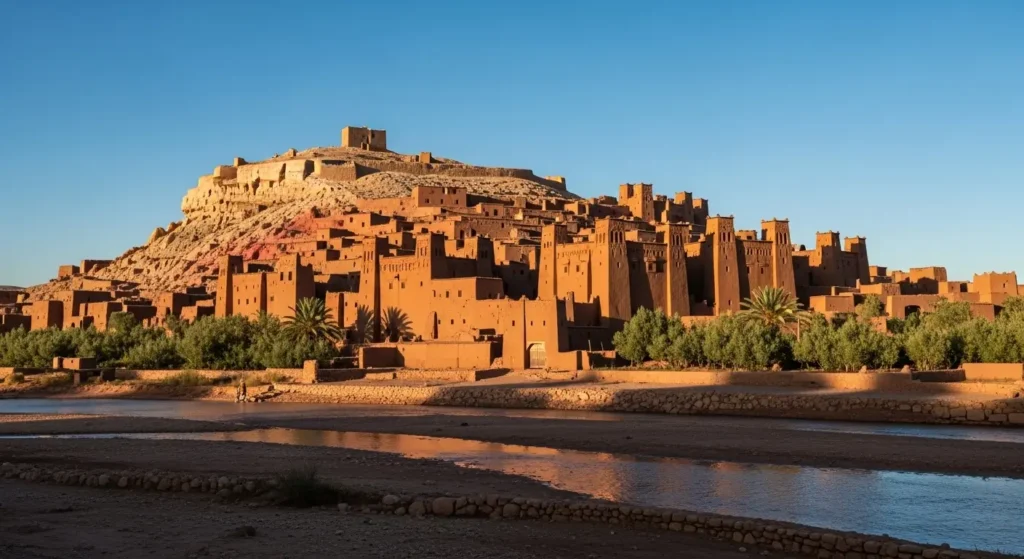
The soul of the region lies in its adobe fortresses. A kasbah is more than just a building; it is a symbol of power and a refuge for families, built of mud and straw and designed to withstand the test of time and the elements.
The crown jewel is Ksar Aït Ben Haddou, an entire fortified village that is a UNESCO World Heritage Site. Its towers and red-earth alleyways are perhaps Morocco’s most famous setting—a place to get lost and travel back in time. Within Ouarzazate itself, the imposing Kasbah Taourirt stands out.
Exploring this former residence of the Pasha of Marrakech is like stepping into a labyrinth of rooms, courtyards, and towers with spectacular views. From here begins the legendary Route of a Thousand Kasbahs, a road that winds through valleys dotted with ancient fortresses, each telling a story of caravans and dynasties.
Part 2: The Journey to the Great Desert—Which Sahara Is Yours?
Venturing into the Sahara is a personal decision, and Morocco offers two distinct experiences—almost like two deserts in one. The big question is: Erg Chebbi or Erg Chigaga?
The Big Question: Erg Chebbi or Erg Chigaga?
The Erg Chebbi Dunes, near Merzouga, represent the “classic” Sahara. They are the tallest and most accessible dunes, forming a sea of orange sand that matches the iconic image many people have of the desert. It is a majestic and visually stunning experience.
On the other hand, the Erg Chigaga Dunes, accessible via M’hamid or Zagora, offer a glimpse of the “wild” Sahara. The journey to get there is longer, requiring a sturdy 4×4 to cross arid plains before the dunes come into view on the horizon.
It’s a more remote, rustic, and fully immersive experience for those seeking solitude and the feeling of being at the end of the world.
Merzouga: A Majestic Experience in Erg Chebbi
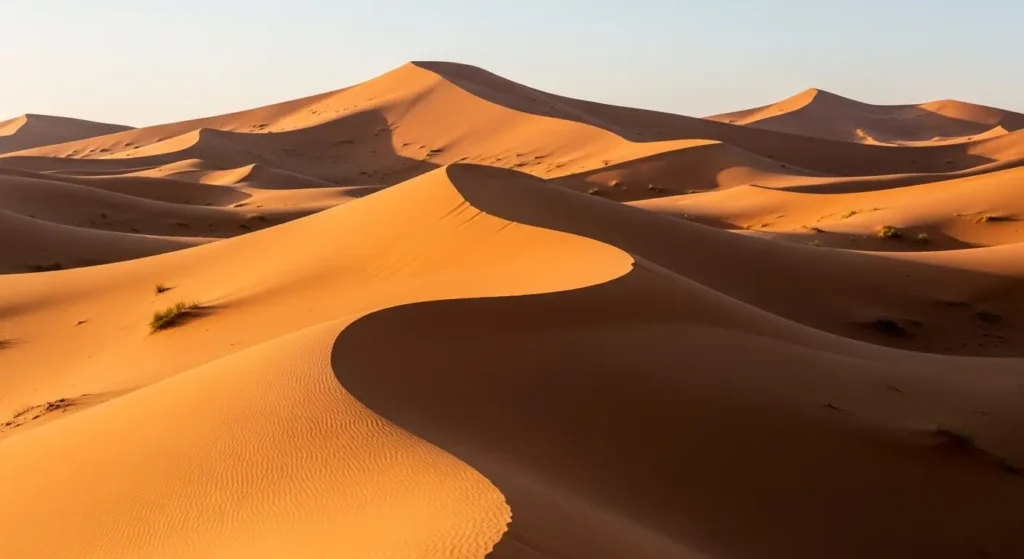
The small village of Merzouga serves as a base for exploring Erg Chebbi. It is from here that camel caravans set out for the heart of the dunes.
The feeling of being surrounded by that sea of sand, whose colors shift from golden to fiery red in the sunlight, is simply unforgettable.
Zagora and M’hamid: The Route to Adventure in Erg Chigaga
The journey to Chigaga is an adventure in itself. The route follows the Draa Valley, a winding oasis, passing through Zagora, famous for its “52 days to Timbuktu” sign. M’hamid is the last town, the outpost before the deep desert.
The journey from there is all about vastness and simplicity, culminating in an encounter with the wild, untouched dunes of Chigaga.
Part 3: Unforgettable Scenery on the Way to the Desert
The beauty of a trip to the Sahara lies as much in the journey as in the destination. The roads connecting Marrakech to the desert offer a spectacular display of geographic and cultural diversity.
The journey begins as you cross the High Atlas via the Tizi n’Tichka Pass, a winding road that climbs to over 2,260 meters, revealing breathtaking mountain views. Further on, the Dadès Valley and the Todra Gorge impress with their monumental canyons and reddish rock formations, where villages nestle in lush green oases.
In the spring, the Valley of Roses in Kelaat M’Gouna captivates visitors with the beauty and fragrance of thousands of Damask roses, which are used to produce the famous rose water. Heading south, the Draa Valley follows the river of the same name, forming one of the largest palm groves in the world—a ribbon of life that cuts through the arid landscape.
Near Ouarzazate, the Fint Oasis is a well-kept secret—a peaceful retreat with lush gardens and natural pools that contrast with the rocky landscape around it.
Part 4: Essential Experiences for Living in the Sahara
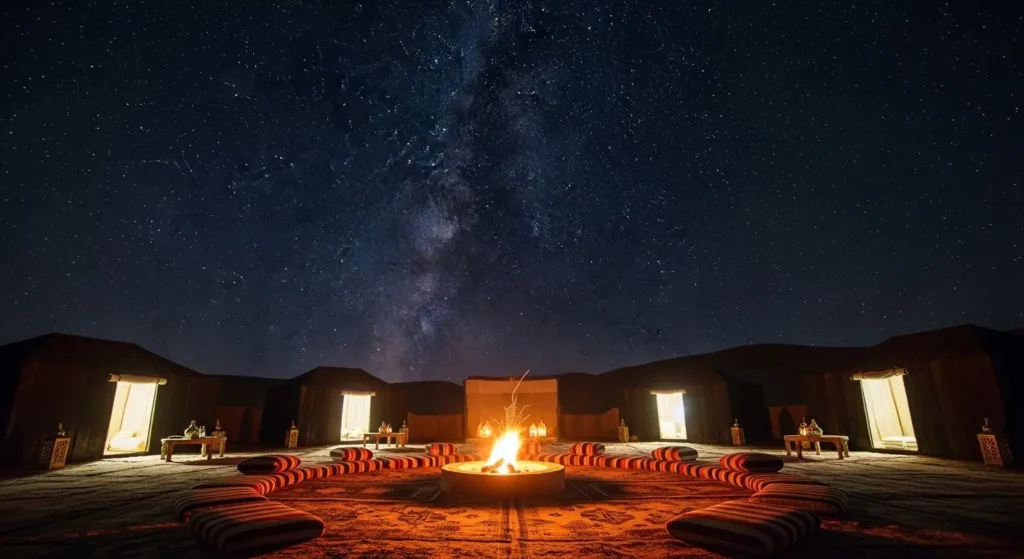
The Sahara is a place to experience with all your senses. The experiences here are rituals that connect travelers to the essence of the desert.
The Camel Ride Ritual is the classic way to explore the dunes. The slow-moving caravan, swaying to the rhythm of the animals at sunset, is not just a mode of transportation, but a meditation in motion. The experience culminates in a night under the stars.
Sleeping in the desert, far from any light pollution, reveals a sky of astonishing clarity. The camps vary in style, ranging from traditional Berber camps—which are more rustic and authentic—to luxury camps, which offer the comfort of private bathrooms and soft beds without sacrificing the magic of the surroundings.
The evening is filled with Berber culture: warm hospitality, the sound of drums around the campfire, and the ever-present mint tea, served as a ritual of friendship. Above all, the most profound experience is that of embracing the silence and the vastness.
It is in the apparent emptiness of the desert that we find a space for inner connection, an introspective experience with nature in its purest form.
Part 5: Practical Guide – Planning Your Trip to the Desert
Planning a trip to the Sahara requires paying attention to a few important details to ensure a safe and comfortable experience.
Frequently Asked Questions
Where to start? Trips usually begin in Marrakech or Fez. From Marrakech, the drive to Merzouga (Erg Chebbi) takes about 9 to 10 hours. From Fez, it takes approximately 7 to 8 hours. It’s a long journey, and you’ll always need to spend the night somewhere along the way.
Is it possible to take a day trip there? The answer is a resounding no. Trying to make a round trip from Marrakech is impractical and fails to do justice to the scale and rhythm of the desert. The trip would lose all its meaning.
How long should you stay? We strongly recommend spending at least two nights in the desert. A single night barely gives you time to arrive, watch the sunset, and leave the next morning. Two nights offer a true immersion, with time to explore, relax, and truly experience the place.
When is the best time of year to visit? Spring (March through May) and fall (September through November) are ideal, with sunny days and pleasant temperatures. Summer (June through August) is extremely hot, with temperatures sometimes exceeding 45°C. Winter (December through February) has mild days but very cold nights, so you’ll need to pack appropriate clothing.
What to wear and pack? Think in layers. Pack light, breathable clothing for the day and warm layers for cold nights. A scarf or turban (shesh) is essential for protecting yourself from the sun and sand. Don’t forget sunscreen, a hat, sunglasses, and a good moisturizer. When visiting villages, opt for more modest clothing.
Is this a safe trip that’s recommended for children? Yes, it’s a safe trip and a fantastic adventure for children, who usually love the camels and the dunes. Just choose an itinerary with a suitable pace and a comfortable campsite for the family.
Useful Information
To visit Morocco, Brazilians do not need a visa for stays of up to 90 days. The official languages are Arabic and Berber, but French is widely spoken in the tourism sector. The local currency is the Moroccan dirham (MAD).
Part 6: Suggested Itineraries (Travel Plans)
Classic Itinerary (3 Days / 2 Nights): From Marrakech to the Merzouga Desert
- Day 1: Marrakesh → High Atlas → Aït Ben Haddou → Overnight stay in the Dades Valley.
- Day 2: Dadès Valley → Todra Gorge → Merzouga (camel ride and overnight stay in the desert).
- Day 3: Merzouga → Return via Ouarzazate → Arrival in Marrakech at the end of the day.
Extended Itinerary (4 Days / 3 Nights): A Deeper Immersion
This itinerary follows the same basic structure as the classic one, but adds an extra night, allowing more time to explore the valleys at a leisurely pace, visit an oasis, or spend a full day enjoying activities in the desert, deepening your connection with the place.
The Great Crossing (3 or 4 Days): Connecting Marrakesh and Fes via the Desert
- Day 1: Marrakesh → Aït Ben Haddou → Ouarzazate/Dades.
- Day 2: Kasbahs Route → Merzouga (overnight in the desert).
- Day 3: Merzouga → Ziz Valley → Midelt → Fez.
Conclusion: The Essence of the Journey
A trip to the Sahara is a journey of self-discovery and connection. It proves that the desert is not a place to be seen, but to be felt. It is the wind that whispers stories, the silence that calms the mind, and the carpet of stars that reminds us of our smallness and, at the same time, of our connection to the universe.
Ready to hear the call of the desert? Get in touch so we can work together to design a travel consultation that reveals the Morocco that comes alive beyond the conventional itineraries.